
HOME DECOR
How to Make a Small Bedroom Feel More Spacious: Simple Ideas That Help
- September 24, 2026
- 8 min read
- By Kiana Meraki
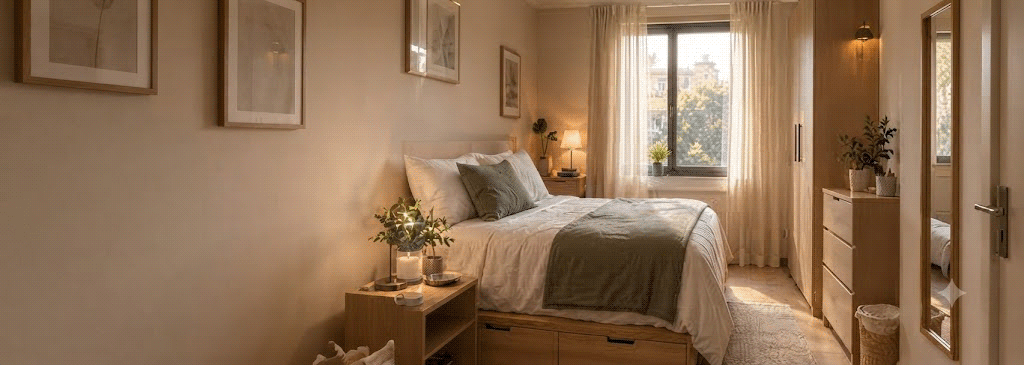
A small bedroom often feels cramped for reasons that have little to do with its size. A bed that’s slightly too big, a dresser that blocks part of the window, storage eating into the floor, and a scatter of small objects on every surface can make a modest room feel much tighter than it needs to.
Emptying the room isn’t the answer either. You still need somewhere to sleep, get dressed, store things, charge your phone and move around without turning sideways. A small bedroom doesn’t have to look bare to feel spacious. It needs enough breathing room for the furniture, light and storage to work together.
Start With the Layout, Not the Decor
Before you buy a mirror, repaint or add baskets, look at the furniture you already have. The biggest pieces affect how the room feels more than anything else, so start there.
The bed is usually the anchor. Can you walk around it comfortably? Is other furniture competing with it for the same strip of floor?
Then ask what each smaller piece is contributing. A chair that mostly collects clothes is taking up space without doing its job. A large bedside table holding very little might be better replaced by a narrower one or a wall-mounted shelf. You don’t have to remove furniture just because the room is small. The question is whether each piece earns the floor it sits on.
Fit the Furniture to the Room, Not Just Into It
A bed may technically fit. So may a dresser, a chair and a desk. Together, they can leave almost nowhere for the room to breathe.
That’s why a rule like “small room, tiny furniture” doesn’t always help. A room full of undersized pieces can look fragmented, with lots of little shapes and no calm areas. Often it’s better to have fewer, properly scaled pieces.
Start with the bed, then add only what the room needs. If two bedside tables make it awkward to get around, try one. If a full-size dresser blocks a walkway, consider a narrower storage piece and move some of its contents elsewhere.
Edit Before You Buy Storage
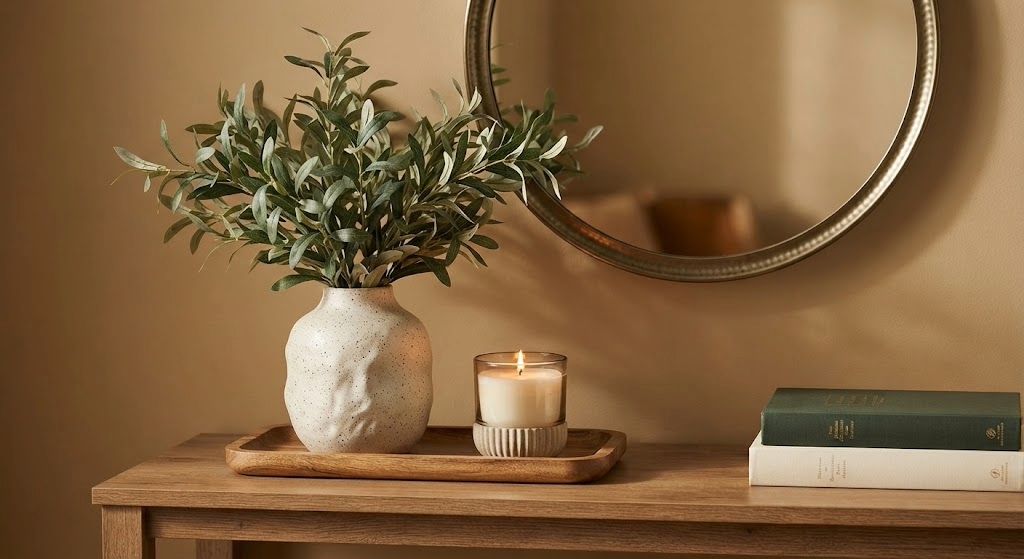
Storage helps, but it doesn’t fix clutter by itself. A new cabinet can just give things you don’t use somewhere to sit. First decide what doesn’t need to be in the room:
- Clothes that are no longer in regular rotation
- Decorative objects with no meaning or use
- Piles of books you’re unlikely to read soon
- Cables and chargers left out on surfaces
- Bags, shoes and laundry with no proper home
You don’t have to hide everything. A few books, some artwork, a lamp or an object you like can make a bedroom feel like yours. The difference is between things you’ve chosen to display and things that have simply accumulated. If every flat surface is covered, the room feels busy even when the layout is fine.
Use the Space You’re Not Using
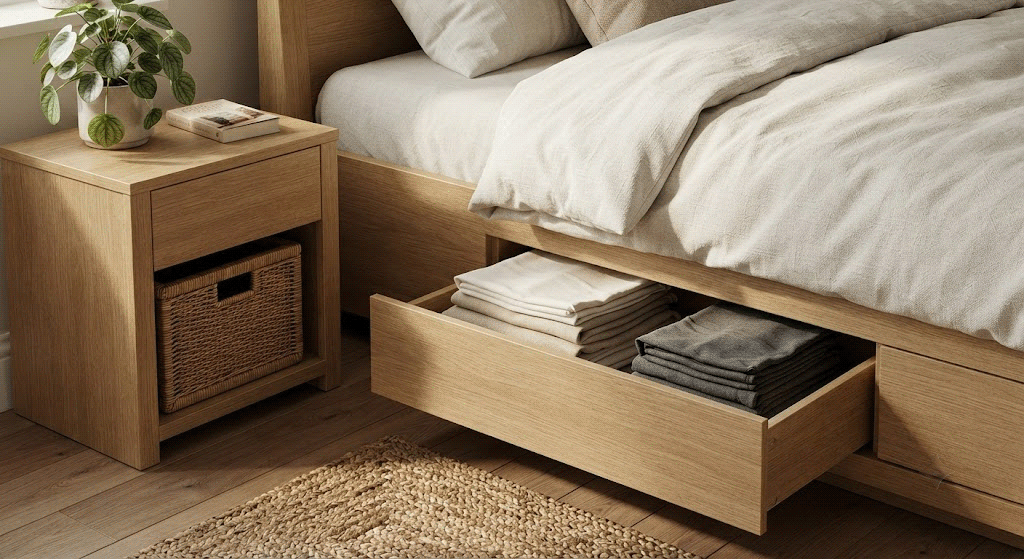
Once you’ve edited, look at what still needs a home. Small bedrooms often have usable space that’s being ignored: above the door, under the bed, behind the door or along an empty stretch of wall.
Some of the more useful options include:
- Under-bed storage for things you don’t need often
- Wall-mounted shelves and hooks
- Floating bedside tables, or ones with drawers
- A wardrobe that uses the full height of the wall
- Baskets for everyday items
- A storage bench, if you actually need the seating
Vertical storage is especially useful because it uses wall space instead of floor space. Closed storage can also help the room feel calmer. Not everything you own needs to be visible just because there’s a shelf. 📎
Keep the Floor as Open as You Can
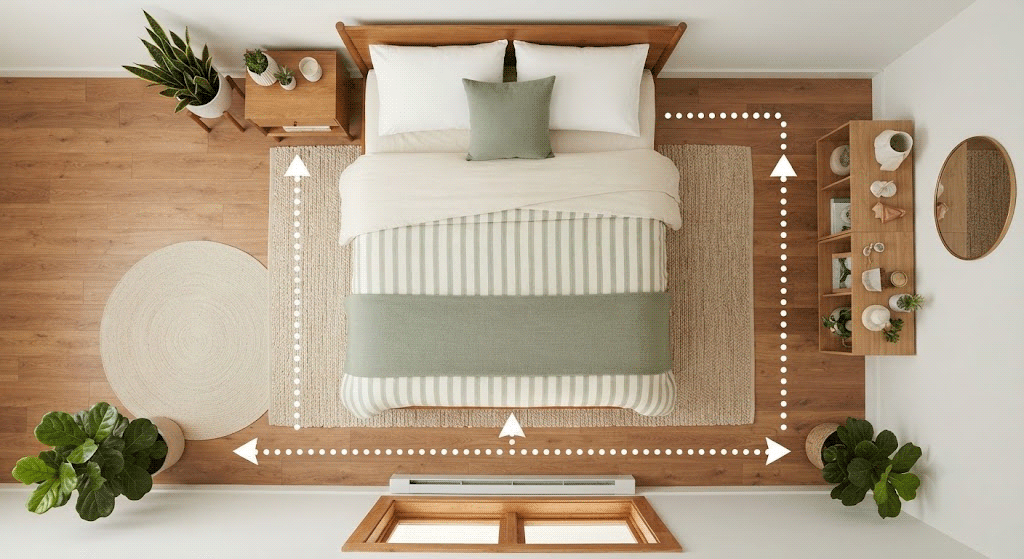
Floor area has a strong effect on how crowded a room feels. You don’t need it completely bare, but avoid the gradual build-up of small obstacles: a laundry basket, a storage box, a floor lamp, an oversized chair.
Moving a few functions up the wall, such as a wall light, hooks or a floating bedside shelf, can free up more floor than you’d expect.
Think about the rug too. A rug that’s too small or awkwardly placed can visually break up an already compact floor. Rather than choosing the smallest one that fits, consider how the rug relates to the bed and nearby furniture. It should help connect the main pieces rather than look like a separate island in the middle of the room.
Let the Window Do More
Good use of daylight can make a small room feel lighter and more open, so try not to block the window. A tall wardrobe in front of it, or heavy curtains that stay closed all day, can make the room feel visually heavier.
Sheer or light-filtering curtains can let daylight in while still providing privacy. If you need darkness to sleep, combine them with blackout curtains or a blind that you can open during the day. Where you can, position large furniture so it doesn’t cut across the path of light from the window. 📎
Use Lighting to Create Depth
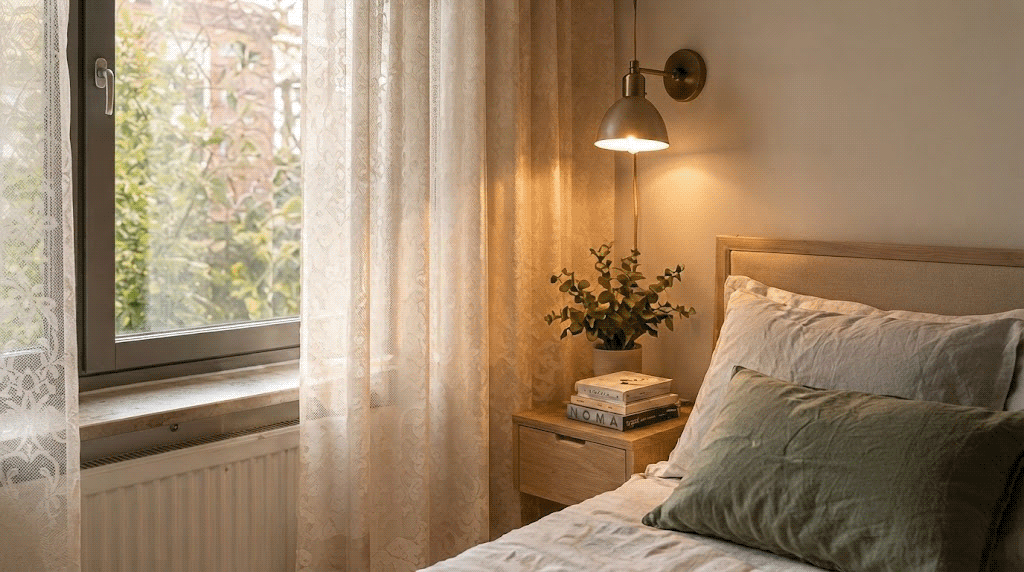
One central ceiling light is a blunt tool in a small room. A few well-placed sources can do more than one harsh light: general light for dressing and cleaning, a lamp for reading, and softer light for the evening.
Multiple light sources can also spread attention around the room and make darker corners feel less visually heavy. Wall sconces suit bedrooms with little bedside space because they leave the surface free. If you rent or can’t change the walls, a small table lamp is the easier option.
In a crowded room, choose lighting that solves more than one problem.
You Don’t Have to Paint Everything White
Light colors can make a room feel airy, but an all-white room with oversized furniture and cluttered surfaces can still feel cramped. A darker room can feel comfortable, even surprisingly roomy, when everything in it fits together.
What matters is how surfaces relate. Similar tones across the bedding, curtains, rug and larger furniture can help the eye read the room as one space rather than a collection of separate objects.
You can still use contrast, but be deliberate about where. A dark headboard against a soft neutral wall can look intentional. Lots of unrelated high-contrast objects scattered around the room can create visual noise.
Colour is useful, but it works best as a refinement after the layout and clutter have been addressed.
Mirrors: Useful, but Not Automatic
A mirror can add depth by reflecting light. That doesn’t mean every small bedroom needs a huge one.
A mirror can work well opposite or beside a window, on a wardrobe door, above a dresser or on a wall that would otherwise stay blank.
Check what it will reflect. A mirror showing a bright window or a calm part of the room can add a sense of depth. One facing a cluttered corner just gives the clutter a second appearance.
Make the Walls Work
When there’s little floor space, the walls can take over some jobs: a shelf, hooks, a reading light, a mirror, artwork or a narrow bedside ledge.
Vertical elements can also draw the eye upward, which may help the room feel taller.
But don’t turn the walls into another place to dump things. A wall covered in unrelated shelves and frames can create the same busyness as a crowded floor.
Textiles: Related, Not Identical
Bedding, curtains, rugs and throws take up a lot of visual space, so how they work together matters. They don’t need to match exactly. A fully coordinated set can look more like a showroom than a bedroom.
Try a small family of colors and let texture supply the variety—for example, several related neutrals in linen, cotton, wool and woven materials. This gives the eye something to move across without creating a pile of competing patterns.
Common Mistakes
- Buying storage before editing. More cabinets can just mean more places for unused things.
- Choosing only tiny furniture. Several undersized pieces can make the room look fragmented.
- Filling every wall and surface. A few pieces with space around them often have more presence than many small ones.
- Blocking the window with a tall wardrobe or heavy curtains.
- Relying on white paint. Colour can’t make up for a poor layout or too much furniture.
- Placing a mirror without checking the reflection. It will show the mess as well as the light.
- Buying before rearranging. Try moving what you have first. The problem may be placement, not a lack of products.
- Filling every empty corner. Some empty space is what makes the useful parts of the room comfortable.
What to Do First
If the room still feels cramped and you don’t want to spend much, work in this order:
- Fix the layout. Start with the bed and biggest pieces, and keep clear paths to walk.
- Clear the clutter. Empty floors and surfaces before buying organizers.
- Improve storage. Use under-bed, vertical or built-in options for what genuinely needs to stay.
- Sort the lighting. Use daylight better and add lower or focused light where needed.
- Finish with colour and decor. Textiles, mirrors and artwork come last because they’re the easiest elements to change and usually aren’t the most important place to start.
A Simple Reset: Edit → Arrange → Light → Store
When you don’t know where to begin, use four steps:
Edit: Remove what isn’t useful or meaningful enough for the space.
Arrange: Place the largest furniture first and keep enough room to move around it.
Light: Use daylight properly and layer artificial light so the room doesn’t depend on one harsh source.
Store: Move everyday clutter into under-bed, vertical or other overlooked storage.
The order matters. It prevents the most common mistake: trying to fix a layout or clutter problem by buying more things.
Enough Room to Live Comfortably
A good small bedroom doesn’t look like a large one with the furniture taken away.
It feels spacious because you can walk around without navigating furniture, your belongings have somewhere to go, the bed feels like a place to rest, and the room still has some personality.
Before doing anything else, work out what’s making the room feel small. It might be too much furniture, clutter, an awkward layout, blocked daylight or harsh lighting.
Fix that first. Then use color, mirrors and textiles to refine the room rather than relying on them to solve the underlying problem. 📎