
HOME DECOR
Modern Living Room Ideas: Simple Ways to Refresh Your Space
- September 14, 2026
- 7 min read
- By EverMuse
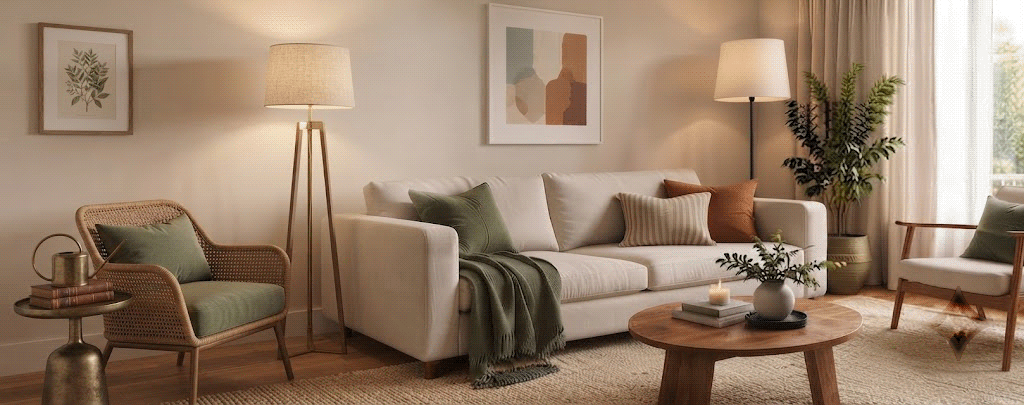
A modern living room doesn’t have to mean a brand-new sofa, designer furniture, or a full renovation.
Sometimes the room already has most of what it needs. The sofa is comfortable enough. The coffee table works. The walls are perfectly usable. What’s missing is a sense of balance — the furniture feels crowded, the lighting is harsh, or small decorative pieces have accumulated without much direction. In situations like that, buying more things can actually make a room feel less finished.
A better approach: figure out what isn’t working first, then spend where the change will actually matter.
A modern living room is often less about owning “modern” furniture and more about proportion, lighting, colour, texture, and visual breathing room. You don’t have to address everything at once — a few thoughtful changes can make a room feel considerably more intentional, even on a very small budget.
What actually makes a living room feel modern?
Modern doesn’t have to mean stark, white, empty, or ultra-minimal. It can be warm, colourful, natural, even slightly eclectic. What tends to make a room feel contemporary is that the elements work together rather than compete for attention.
Five things have an especially noticeable effect:
Layout
Furniture should let people move through the room comfortably and make conversation easy.
Lighting
A mix of ambient, task, and accent lighting usually feels more considered than relying entirely on one ceiling fixture.
Colour
A restrained palette creates cohesion even when the room mixes several materials or patterns.
Texture
Wood, fabric, glass, metal, woven materials, and greenery keep a simple room from feeling flat.

Visual clutter
Surfaces don't need to be empty, but every object on them should have a reason to be there.
This is why a fairly inexpensive change can sometimes improve a room more than an expensive one. If the real problem is an awkward layout or too much visual clutter, a new piece of furniture won’t fix it.
Start with what you already have
Before buying anything, spend a little time editing the room. Clear unnecessary objects off coffee tables, shelves, and side tables. Put away what doesn’t need to be on display. Then look at the furniture itself.
Could the sofa move slightly? Would the chairs work better facing each other? Is the coffee table too far from the seating to be useful? Does one part of the room feel empty while another feels cramped?
Try a few arrangements before deciding anything needs replacing — and don’t just add. Temporarily removing a few decorative objects and living with a simpler room for a few days often makes it much easier to see what’s actually missing.
Before spending anything, ask what you could take away. It’s usually the cheapest update available, and the one people skip because it doesn’t feel like “doing” anything.
Ideas for a very small or no-cost budget
You can make a surprising difference here without buying furniture.
Rearrange the furniture first. Pull pieces slightly away from the walls where the room allows it, build a more natural conversation area, or simply turn a chair to face where people actually sit. The goal isn’t a “correct” layout — it’s a room that’s easier to use.
Edit your surfaces. Instead of decorating everything, pick one or two areas to style with intention. A coffee table might need only a small stack of books and one object; a shelf usually breathes better when it isn’t fully loaded.
Work with the lighting you already have. Move a lamp closer to where people actually sit. Adjust curtains to make better use of daylight. Small repositioning like this changes how a room feels in the evening more than you’d expect.
Rearrange your textiles. If you already own cushions and a throw in complementary colors, moving them between seating areas or refolding them can make the room read as more coordinated — without buying anything new.
Small-budget changes that make a difference
Once you’re ready to spend a little, focus on elements that shift the whole room rather than small decorative objects.
Refresh the cushions and throws. Textiles are one of the easiest ways to change a room’s character, and you don’t need every cushion to match — a connection in color, texture, or pattern reads more natural than a perfectly coordinated set.
Improve the curtains. They take up more visual space than people expect, so curtains that feel too short, too heavy, or disconnected from the room can undercut everything else. Height and width both affect how the windows — and the room — read.
Add a better light source. If the room depends almost entirely on one overhead light, a floor or table lamp introduces a second, softer level of brightness for when you don’t need everything fully lit.
Choose one substantial piece of wall art rather than covering a wall with small frames. Proportion is what makes it work — something too small on a big wall looks accidental, while one appropriately scaled piece reads as deliberate.
A mid-range budget: choose one anchor
With more room to spend, resist buying several things at once. Pick one element that will noticeably change the room instead.
A rug is often the strongest option — it visually connects the seating area and adds color and texture at the same time. Make sure it’s large enough to relate to the furniture rather than looking like a small island under the coffee table.
A larger mirror can shift a room’s character too, particularly positioned where it reflects good light or an attractive corner.
A coffee table may be worth replacing if the current one is the wrong size or poorly suited to the seating — not simply because it’s no longer trendy.
An accent chair makes sense when the room genuinely needs another seat, not because there’s an empty corner to fill.
The principle underneath all four: buy for a problem, not for an empty space.
If you have a larger budget
More budget doesn’t change the basic rule — don’t replace what’s already working. A sofa may deserve an upgrade if it’s uncomfortable, damaged, badly proportioned, or wrong for how the room gets used. Replacing a perfectly good sofa just because the room doesn’t feel modern is an expensive way to solve the wrong problem.
If you are spending more substantially, put it toward pieces that affect comfort and structure: a well-proportioned sofa, a quality rug, better layered lighting, durable curtains, real storage, or one distinctive piece of furniture or art. A room tends to feel more considered when a few important pieces are chosen carefully than when every surface gets something new.
How to make a room look more expensive without overspending
The feeling of a well-designed room doesn’t come from expensive materials. It usually comes from restraint.
Keep the colour palette connected. You don’t need to stay neutral — a room can be colourful and still feel sophisticated when the colours relate to each other.
Mix textures. A smooth coffee table, soft upholstery, a woven basket, wood, glass, and a textured rug create depth without needing much decoration on top.
Pay attention to scale, which is one of the easiest details to overlook. A tiny rug can make a seating area feel disconnected; very small artwork disappears on a large wall; an oversized sofa can make everything around it feel cramped. Consider the size of anything you buy in relation to what it sits next to.
Hide what doesn’t need to be seen. Modern doesn’t mean an empty room — it means enough visual order that the things you actually want to see can stand out. Closed storage, baskets, and simple containers keep everyday items from taking over visible surfaces.
When the room feels unfinished, try removing three things before buying one. When a room feels unfinished, editing can be more useful than adding.
Ideas for renters
Renting doesn’t rule out a modern living room — it just narrows which improvements make sense. Rugs, curtains, freestanding lamps, mirrors, cushions and throws, indoor plants, freestanding storage, and artwork that can come down without wall damage (where your agreement allows it) can all move with you.
Check your rental terms before touching walls, fixtures, paint, or built-in lighting. The advantage of temporary improvements is exactly that — a good rug or lamp doesn’t stop being useful just because you move.
Mistakes worth avoiding
Choosing furniture too large for the room. A beautiful piece is still the wrong choice if it restricts movement or overwhelms everything around it.
Relying on one harsh overhead light. Even a well-decorated room feels uncomfortable under a single bright source.
Following a trend too literally. A room doesn’t need to reproduce a photograph — take the parts you genuinely like and adapt them to your own space.
Buying too many small decorations. Several inexpensive objects often create more visual noise than one well-chosen piece.
Decorating before solving the layout. Accessories can’t fix furniture that’s fundamentally in the wrong place.
A simple order for spending your budget
If you’re not sure where to start, work through the room in this order:
- Layout and decluttering
- Lighting
- Textiles
- Rug or another major anchor
- Wall art and mirrors
- Storage improvements
- Optional decorative pieces
This isn’t a strict rule — if your lighting is already good but the sofa is uncomfortable, your priorities will naturally shift. The point is to solve the biggest problem first.
A modern living room can be built gradually
You don’t need to finish your living room in one weekend.
Take a photo of the room and look at it with fresh eyes. Is the seating crowded? Does part of it feel empty? Is the lighting too harsh? Are the surfaces overwhelmed with objects? Is there enough texture?
Start with the most obvious problem, even if the fix costs nothing. Then make one thoughtful change at a time.
A modern living room isn’t defined by how much you spend. It’s defined by how well the pieces work together and how comfortably the room supports the people actually living in it. Good design isn’t necessarily about buying better things — sometimes it’s about making better choices with what you already have.